




How to Lead People Who Are Hard to Manage
Ask any leader, pastor, or business owner in Kitale what keeps them awake at night, and they won’t tell you it’s the workload. They will tell you it’s that one person on their team.
You know exactly who they are. It’s the brilliant employee who delivers great results but possesses an toxic attitude that poisons the office culture. It’s the deeply dedicated church member who has been around for ten years but passive-aggressively resists every single new idea you try to implement. It’s the contrarian who argues during board meetings, the micromanager who refuses to delegate, or the team member who constantly nods in agreement but fails to follow through.
When you are dealing with difficult personalities, leadership stops feeling like a calling and starts feeling like a combat sport.
It is incredibly tempting to react out of frustration—to issue angry ultimatums, pull rank, or worse, ignore the behavior and hope it goes away on its own. But real leadership isn't about managing easy people. Your true test as a leader is how you guide, redirect, and handle the people who are hard to manage.
If you are ready to stop fighting fires and start transforming friction into cooperation, you need to upgrade your emotional and strategic toolkit. At the Apostolic Theological & Technical Training Center (AT&TTC) in Kitale, we teach leaders exactly how to decode human behavior and lead high-conflict personalities with absolute composure.
Here is the strategic blueprint for leading the unmanageable.
1. Separate the Person from the Pattern
When someone challenges your authority or disrupts your team, your natural human instinct is to take it personally. You start viewing them as "the enemy."
Professional leadership requires you to step back and look at the data. Do not label the individual as a "bad person." Instead, focus strictly on their specific, observable behaviors.
-
Is their resistance driven by fear of change?
-
Is their toxic attitude a result of feeling unappreciated or passed over?
-
Do they lack clarity on what is expected of them?
When you change your perspective from "This person is out to get me" to "There is an underlying issue causing this behavior," you shift from an emotional reaction to a strategic resolution.
2. Master the Crucial Conversation
Most leaders tolerate bad behavior for months until they finally snap. By that time, the confrontation is explosive, emotional, and destructive.
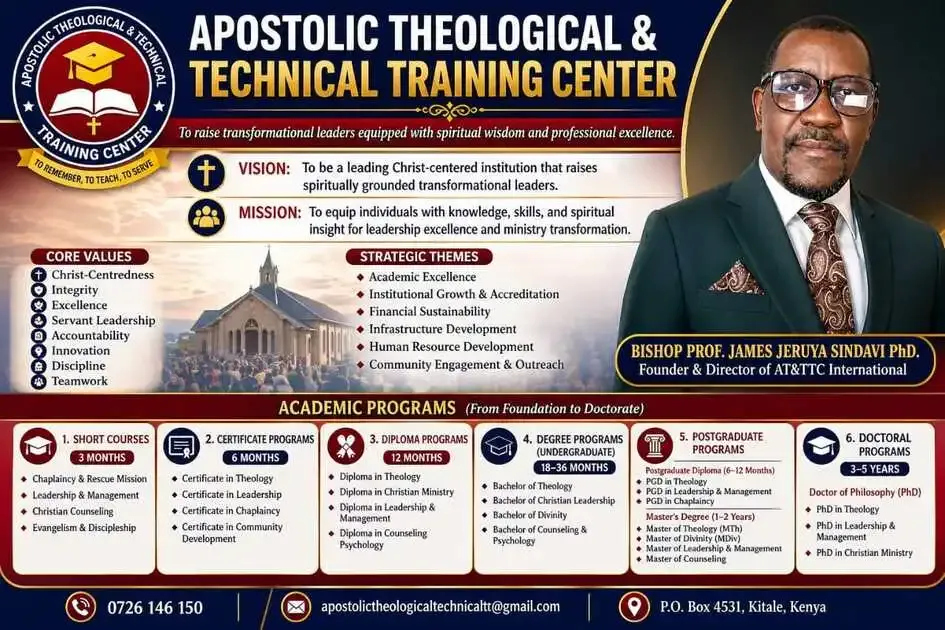
Strategic leaders lean into the friction early through structured, calm, and direct conversations. Under the mentorship of Bishop Prof. James Jeruya Sindavi, PhD at AT&TTC, we train leaders in the art of behavioral counseling and executive communication. When confronting a difficult team member, use this simple framework:
-
State the Facts: Cite specific instances, not vague generalizations. (Say, "You missed the last three project deadlines," not "You are always lazy.")
-
Explain the Impact: Show them how their behavior directly affects the rest of the team or the ministry’s vision.
-
Ask, Don't Tell: Invite them into the solution. Ask, "What is getting in the way of meeting these goals, and how can we fix it together?"
3. Establish Firm, Clear Boundaries
Kindness without boundaries is not leadership; it is weakness. Hard-to-manage people often push the envelope simply because no one has ever given them a clear, unyielding boundary.
You must establish absolute clarity regarding what behaviors are acceptable and what the direct consequences are if those standards are not met. Write them down. Ensure your organizational policies or church structures back you up. When a difficult person realizes that your boundaries are firm and fair, they will either adjust their behavior to fit the culture, or they will choose to leave on their own.
4. Upgrade Your Emotional Intelligence (EQ)
You cannot control how a difficult person acts, but you have 100% control over how you respond. If they raise their voice and you raise yours, they have won. They have pulled you down into their chaos.
The ultimate weapon of a visionary leader is high Emotional Intelligence (EQ). It is the ability to stay completely calm under pressure, read the emotional temperature of a room, and de-escalate tension with quiet authority. True authority doesn't need to shout; it commands respect through emotional stability and sound judgment.
Stop Tolerating Chaos. Learn to Command Respect.
If your leadership style relies purely on your title or your good intentions, difficult people will run circles around you. You need to back up your calling with advanced psychological insights, strategic communication skills, and robust institutional governance.
Don't let one difficult personality drain your energy, sabotage your team, or stall your ministry's progress for another day.
Elevate Your Leadership at AT&TTC Kitale
Whether you need a 3-Month Executive Short Course to handle immediate team conflicts, or you want to pursue a Postgraduate Diploma (PGD), Master's, or PhD in Leadership & Management to master institutional governance, AT&TTC has the perfect program for your schedule.
-
📞 Call or WhatsApp Admissions Directly: 0726 146 150
-
📧 Email: apostolictheologicaltechnicaltt@gmail.com
-
📍 Visit Campus: P.O. Box 4531, Kitale, Kenya
Turn your organizational friction into your greatest breakthrough. Enroll today.