


Imagine you are sitting in a quiet hospital waiting room, completely overwhelmed by bad news. Or maybe you are a soldier stationed far from home, carrying weights your family back home wouldn't understand. Or even an employee at a high-stress corporate firm, staring at a computer screen, feeling burnt out and empty.
In those moments, you don’t necessarily need a traditional church service. You don’t need a 45-minute sermon.
You need a chaplain.
While pastors and priests do incredible work leading congregations from behind a pulpit on Sundays, chaplains do their work out in the wild. They are the frontline workers of spiritual care, operating in places where traditional church structures rarely reach.
Let’s break down what chaplaincy actually is, and why institutions like the Apostolic Theological & Technical Training Center (AT&TTC) in Kitale are seeing a massive surge in people wanting to study it.
So, What Exactly is a Chaplain?
To put it simply, a chaplain is a trained professional who provides spiritual, emotional, and ethical support to people in secular environments.
Think of them as a bridge. They meet people exactly where they are—regardless of their religious background, or lack thereof. A chaplain doesn't enter a space to preach, convert, or judge. They enter a space to accompany. They offer a listening ear, a calming presence, and emotional grounding during some of the worst days of a person's life.
You will find chaplains in:
Hospitals & Hospices: Comforting patients and families dealing with grief, illness, and difficult medical decisions.
The Military & Police Forces: Supporting officers and soldiers dealing with high-stress environments and trauma.
Corporate Workplaces: Helping employees navigate work-life balance, stress, and interpersonal conflicts.
Schools & Universities: Guiding students through mental health struggles and identity crises.
Disaster & Rescue Missions: Providing immediate emotional first aid during crises, accidents, or natural disasters.
Why is the Demand Growing So Fast?
If you've noticed more people talking about chaplaincy lately, it isn’t a coincidence. The world is changing, and traditional setups aren't always enough to handle the emotional toll of modern life. Here is why the demand is skyrocketing:
1. The Post-Pandemic Mental Health Crisis
We live in a world carrying a lot of hidden trauma. Rates of anxiety, depression, and burnout are higher than ever. People are realizing that emotional health and spiritual health are deeply connected. Workplaces and schools are actively looking for professionals who can step in and provide holistic emotional support.
2. People are Stepping Away from Traditional Church, But Not from Faith
Many people today describe themselves as "spiritual but not religious." They might not walk into a church building on Sunday, but when they are facing a crisis in a hospital or a workplace, they still crave spiritual comfort. Chaplains are uniquely trained to provide that care without the pressure of religious politics or dogma.
3. Organizations See the Practical Value
Major corporations, emergency services, and institutions are realizing that when their people are emotionally supported, they perform better. A workplace chaplain reduces employee turnover. A police chaplain helps officers process trauma so they can keep serving safely. It’s no longer just a "nice-to-have" role—it's essential infrastructure.
Moving From "Good Intentions" to Professional Training
Because a chaplain deals with people at their most vulnerable, you can’t just wing it. Having a good heart and a love for God is a great starting point, but it takes specific skills to handle a crisis.
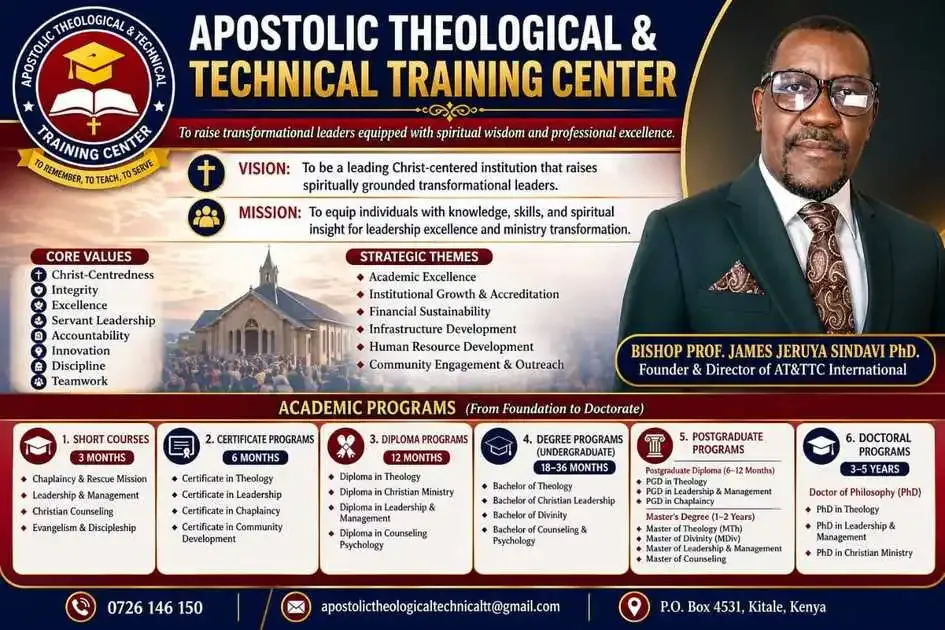
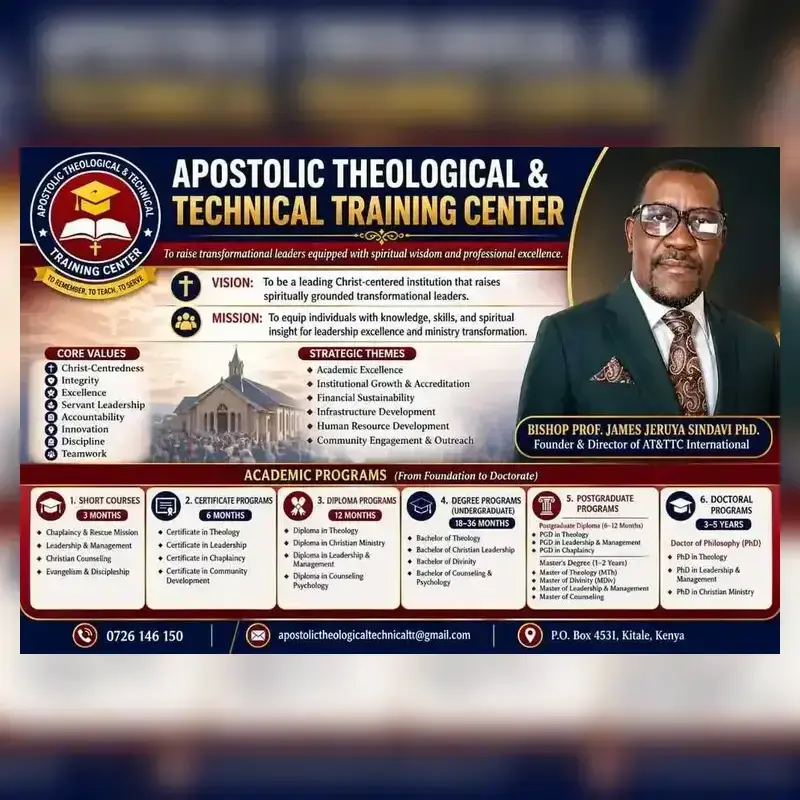
That is where specialized education comes in. At AT&TTC Kitale, under the leadership of Bishop Prof. James Jeruya Sindavi PhD, chaplaincy isn't treated as an afterthought; it’s a core discipline.
The center offers targeted pathways depending on how deep you want to go:
The 3-Month Short Course (Chaplaincy & Rescue Mission): Perfect for first responders, church volunteers, or professionals who want immediate, practical skills in crisis intervention and emotional first aid.
The 6-Month Certificate: A deeper dive into the theology of care, ethics, and counseling basics.
Advanced Postgraduate Diplomas: Designed for those looking to spearhead chaplaincy departments in corporate, military, or medical institutions.
You learn how to listen actively, how to remain calm under extreme pressure, how to respect diverse backgrounds, and how to protect your own mental health while carrying the burdens of others.
Is This Your Calling?
If you have always felt a pull to help people, but the idea of standing behind a pulpit and preaching doesn't feel like the right fit, chaplaincy might be exactly what you are looking for.
It is a career and a ministry where your office is the real world, and your congregation is anyone who needs a helping hand.
Are you ready to take your natural empathy and turn it into a professional, life-changing skill? Get in touch with AT&TTC Kitale at 0726 146 150 or email apostolictheologicaltechnicaltt@gmail.com to explore their upcoming intakes. The world doesn't just need more preachers; it needs more people willing to step into the trenches.